


Automated Media Fill Inspection
LIGHTHOUSE headspace analysis for automated media fill inspection enables
- High sample analysis throughput
- Operator-independent results
- Automatic container reconcilliation
- Inspection of molded and amber glass vials

Headspace analysis for media fill inspection
Laser-based headspace analysis can reliably detect microbial growth in media-filled containers by monitoring oxygen and carbon dioxide levels.
When aerobic microorganisms grow, they consume oxygen and produce carbon dioxide, creating measurable changes in headspace gas composition.
Non-destructive headspace analysis enables accurate identification of contamination, making it ideal for automating media fill inspections and ensuring product safety.

Automated APS
In pharmaceutical manufacturing, an aseptic process simulation (APS), also known as a media fill test, is a critical test that verifies the sterility of an aseptic filling operation. Traditionally, the inspection of media fill samples for microbial contamination has relied on manual visual inspection, a process that is both time-consuming and prone to human subjectivity.

By applying laser-based headspace analysis to detect microbial growth, manufacturers can now automate this inspection step, achieving a faster, more reliable, and fully data-driven process. An automated media fill inspection system eliminates human variability, enhances data integrity, and supports the pharmaceutical industry’s ongoing transition toward digital and automated quality control.
Why Automating Media Fill Inspection Matters
During a media fill test, the actual aseptic production process is simulated using a sterile microbiological growth medium instead of a drug product. By mimicking real production under challenging “worst-case” conditions, manufacturers can verify that the equipment, personnel, and environment are capable of preventing microbial contamination in sterile products.
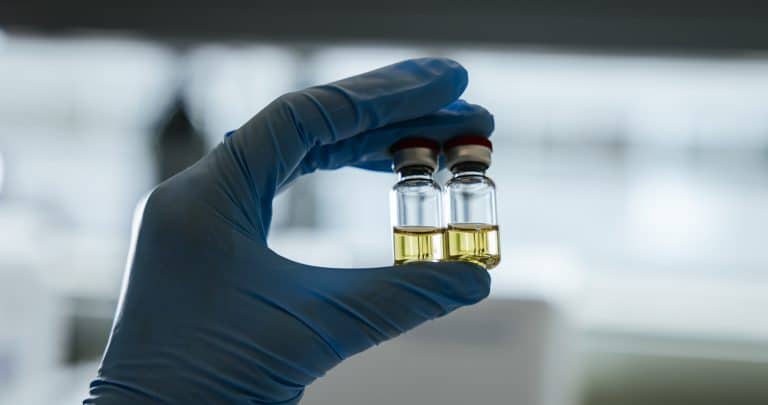
Once the containers are filled with the sterile growth medium, they typically undergo a 14-day incubation period at growth-promoting temperatures. During, and after this incubation period, operators visually inspect each container for turbidity, which serves as an indicator of microbial contamination.
As can be imagined, this manual inspection process is slow, tedious, and highly labor intensive. Completing a single media fill test can take anywhere from several days to a month, depending on the number of vials in the batch. Because the process relies entirely on human observation, it is also inherently subjective. Two operators might interpret the same vial differently, and factors like fatigue, lighting, and visual acuity can all affect accuracy.

Beyond operator variability, data integrity and validation pose additional challenges. Manual recording and reconciliation introduce opportunities for transcription errors or incomplete data capture. Given that media fill tests must be performed at least twice a year, and more frequently with more aseptic filling lines in operation, the cumulative time, labor, and documentation burden is substantial.
Automation directly addresses these concerns by replacing subjective, human-dependent assessments with objective analytical data. Automated media fill inspection systems, such as those based on laser-based headspace analysis, offer a consistent and data compliant method for identifying microbial growth. Automation also fits the industry trend toward removing manual steps from critical quality control processes, improving both efficiency and data compliance.
How Laser-Based Headspace Analysis Detects Microbial Growth
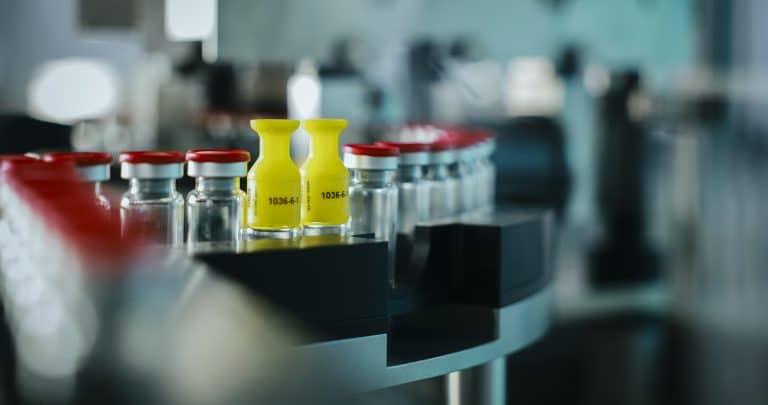
Laser-based headspace analysis is an advanced, non-destructive analytical method that directly measures gas concentrations inside sealed parenteral containers. It was introduced to the pharmaceutical industry in the early 2000’s and is now an accepted method mentioned in USP chapters <922> and <1207>. It is used for a wide range of applications, and microbial growth detection can be one of them.
When microorganisms begin to grow, they release carbon dioxide. This changes the gas concentrations in the headspace of a product container. Because non-destructive headspace analysis directly measures headspace gas concentrations inside sealed containers, it is perfect for demonstrating microbial activity.

Oxygen and Carbon Dioxide Changes During Microbial Growth
Multiple scientific studies have demonstrated how to use laser-based headspace analysis to detect microbial growth in an aseptic process simulation (APS). An early publication from 2016, demonstrates that media filled vials inoculated with a range of compendial organisms consistently show a rapid drop in headspace oxygen levels during the exponential growth phase.
At the same time, carbon dioxide levels rapidly increase. The characteristic O₂ and CO₂ curves differ among microorganisms, but in every case, headspace analysis can detect these changes when contamination becomes visible.
Additional studies looked at the impact of different container formats and growth medium, using a wider range of microorganisms including bacteria, fungi and slow-growing strains.
All the performed studies show that laser-based headspace analysis can accurately detect microbial growth across all tested organisms within the standard 14-day incubation period. The method even detects growth under challenging conditions such as low inoculation levels and stressed organisms.
Non-Destructive and Rapid Measurements
Laser-based headspace analysis can analyze a single vial in less than a second and depending on the used platform, these systems can process up to 18000 vials an hour. In addition, all the analyzed data is stored in a 21 CFR part 11 compliant database.
Replacing Manual Media Fill Tests with Automation
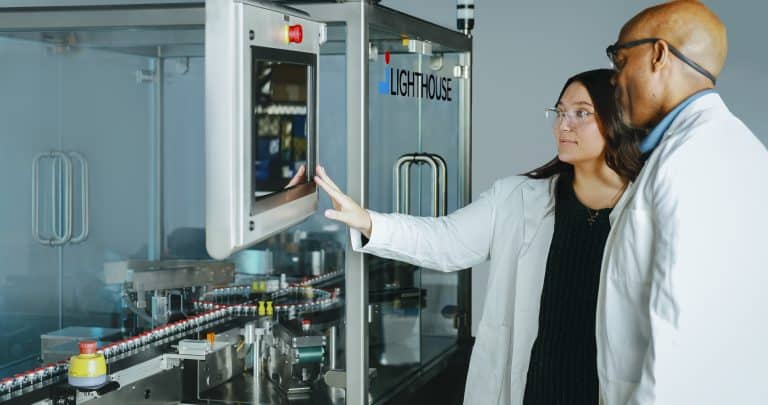
Instead of taking multiple days to complete a media fill inspection, automation promises results within a day. Automation also simplifies data handling and container reconciliation. Using laser-based headspace analysis, each container is measured for changes in headspace gas composition indicating microbial growth. The data is immediately logged in a secure CFR compliant database creating a complete digital record of the inspected batch.
In short, laser-based headspace analysis has the potential to fully replace the subjective “look and compare” approach with a data-driven and analytical process, ensuring full traceability for every media fill test.
Benefits of Automated Media Fill Inspection
Using laser-based headspace analysis for automated media fill inspection has many operational and analytical benefits for pharmaceutical manufacturers:
- Operator Independent Results
Laser-based headspace measurements ensures that growth detection is based on measurable gas changes rather than visual interpretation. - Higher Inspection Throughput
Automated systems can inspect up to 18000 vials an hour, significantly reducing total inspection time. This in turn, results in faster completion of aseptic process simulations and shorter production downtime. - Enhanced Data Integrity and Traceability
Each measurement is stored in a 21 CFR part 11 compliant electronic database. This supports compliance with data integrity standards and simplifies regulatory audits. - Reduced Labor Requirements
By automating a previously manual and tedious task, manufacturers can reallocate skilled personnel to higher-value quality functions, lowering overall operational costs. - Directly Measure Difficult to Inspect Containers
With laser-based headspace analysis, it is possible to inspect containers that are usually difficult to inspect manually, such as molded or amber glass vials or small volume syringes.
Collectively, these benefits make automated media fill inspection very attractive for any facility conducting aseptic process validation.
Automated Media Fill Inspection
Automated Media Fill Inspection

How to Implement Automated Media Fill Inspection
Transitioning to an automated media fill inspection requires a careful, stepwise approach, especially given the critical nature of aseptic process simulations. Manufacturers that are interested in exploring automation can start by gaining hands-on experience with laser-based headspace analysis at a small scale.
Scientific studies have already shown that headspace analysis can detect microbial growth across a wide range of organisms, including standard compendial microorganisms and common house isolates. To help you evaluate how laser-based headspace inspection can simplify your media fill inspections, you can lease our benchtop carbon dioxide analyzer. Use this system while performing growth promotion testing to observe how it accurately quantifies increasing CO₂ levels as microorganisms grow. This allows you to gather real data, understand the relationship between microbial activity and headspace gas changes, and assess how the technology performs in your specific environment.

Once familiar with the method, manufacturers can define detection thresholds for headspace gas changes that align with growth of their microorganisms. While every facility will have its own method development approach, the general process focuses on confirming measurement repeatability, assessing detection limits, and documenting analytical performance.
By starting small, and collecting data during growth promotion tests, pharma manufacturers can gain valuable operational experience with headspace analysis. This practical, data-based approach enables an informed transition from manual to automated media fill inspection.
Get in touch with Rick
Do you have questions about our services or need expert advice for your project? Our dedicated team is here to help. Contact us today to learn how we can support your specific needs.
