Knowledge Center
Water Activity and Primary Packaging Selection for Oral Solid Dosage Products
Water activity (aw) is the partial vapor pressure of water in a substance divided by the partial water vapor pressure of pure water at the same temperature. For an oral solid dosage (OSD) product, it directly indicates the loosely bound or free water available for chemical, biochemical or physical reactions. It also links the product to its package: aw × 100 = % ERH, the equilibrium relative humidity inside the package.
Primary packaging must keep the humidity inside the package low for as long as needed to protect potency, purity, dissolution rate, tablet hardness and capsule swelling up to the expiration date. In development, you need to know whether an existing package gives adequate protection; for a commercial product, whether a replacement package performs equivalently. This article explains how water activity determination supports those decisions.
What USP 671 permeation testing covers
USP <671> Containers – Performance Testing defines methods for determining the moisture vapor transmission rate (MVTR) of a primary package. MVTR is measured by the weight of water absorbed by a specified weight of desiccant placed inside the package, at 30°C/65% RH or 40°C/75% RH. It is expressed as milligrams per day per package volume (mg/day/litre).
MVTR describes the barrier the package provides. It does not, by itself, tell you the humidity inside the package once it is sealed with your product, or how your product’s water activity changes over its shelf life.

How water activity complements USP 671
USP <922> Water Activity states that water activity determination can be used to establish the level of protection that primary packaging provides to a product over its shelf life. Water activity data does not replace USP <670> Auxiliary Packaging Components or USP <671> testing. It expands and complements them by answering two questions your packaging and QC teams need to address:
- What is the relative humidity inside the package when it is first sealed (RH0)?
- How does that humidity change over time (RHt)?
In one study, blisters filled with water were measured daily for two weeks, and the results suggest that moisture permeation is not linear but exponential. When water activity is also tested at each stability pull point, you build a history of batch quality over time. An individual package that fails to meet its critical quality might then be detectable by elevated water activity compared with historically acceptable batches.
The same principle applies beyond OSD. For freeze-dried products, see water activity as a better approach for lyo moisture determination, or explore our broader moisture determination applications.
Selecting packaging for a moisture-sensitive OSD product
The starting humidity inside a package can range from as little as 10% to as high as 60% RH, depending on the product and packaging. Measured values for common over-the-counter products illustrate the spread: an enteric-coated aspirin tablet in an HDPE bottle with a 1 g desiccant had an aw of 0.17, while an uncoated ibuprofen tablet in an HDPE bottle without desiccant had an aw of 0.52. Two blister-packed products measured 0.37 and 0.57.
Desiccants change these starting conditions. In one example, tablets sealed with desiccant in a glass vial went from 60% to 8% RH in approximately 14 hours, as water moved from the formulation to the desiccant. The effect of desiccant type, desiccant amount and tablet count on RH0 could be assessed quickly.
The article also compares one tablet formulation in four configurations: HDPE bottles with 7 or 30 tablets, and blisters made from low-MVTR and high-MVTR film. Packages were stored at ICH Q1A accelerated conditions of 40°C/75% RH, and water activity was measured at 60, 90 and 180 days.
Measuring water activity with laser-based headspace analysis
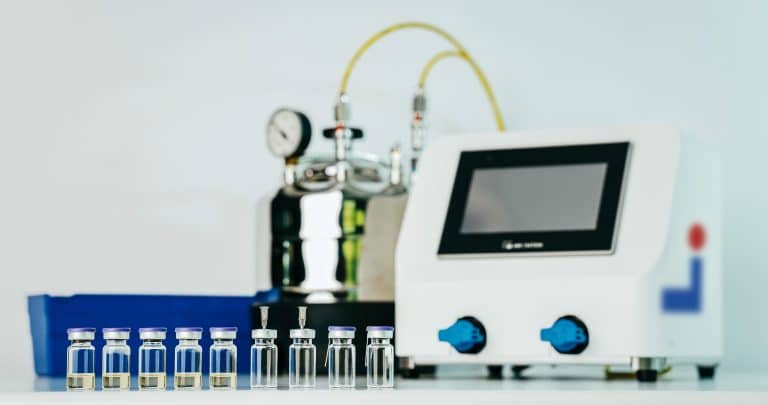
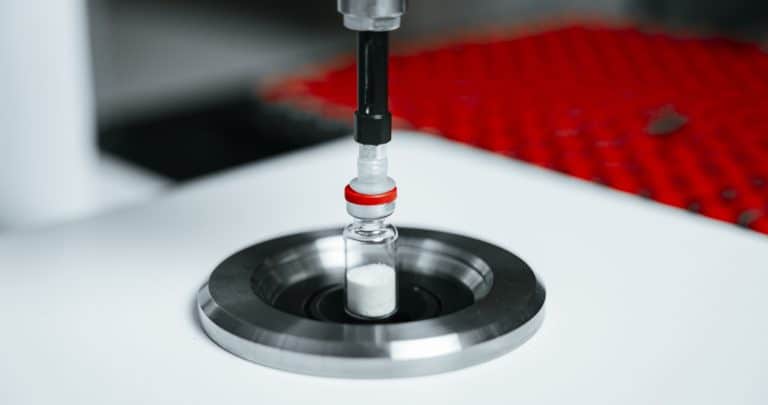
RH0 cannot be accurately estimated or calculated, but it can easily be measured by testing one tablet from each package 1–2 days after sealing. The data in the article was collected with the FMS-Water Activity Analyzer, which uses tunable diode laser absorption spectroscopy. Samples are measured in closed containers, which avoids cross-contamination, and data can be collected at 25°C, 30°C and 40°C.
This technique is described in USP <922>, which identifies it as the only method that can correctly measure water activity when the sample contains other volatile compounds.
Discuss water activity testing for your packaging
Download the article for the full data set, or talk to one of our application scientists about using water activity alongside USP <671> in your packaging selection.