

CCIT is not a regulatory checkbox but a safeguard for patient safety and product efficacy. Global regulatory agencies expect CCIT to be based on scientifically sound, preferably deterministic methods tailored to the specific product and container system, so a validated method is central to demonstrating compliance throughout the product life cycle.
CCIT Method Development and Validation
Container Closure Integrity Testing (CCIT) isn’t just a regulatory checkbox; it’s a critical safeguard for patient safety and product efficacy. For sterile injectables, even the smallest packaging defect can lead to loss of efficacy, reduced shelf life, product loss or worse, loss of sterility.
Explore LIGHTHOUSE’s full range of CCIT solutions to see how deterministic testing protects your product throughout its life cycle.
Whether you are preparing for clinical trials or scaling commercial production, validated CCIT methods tailored to your container system and product are essential. Read on to explore a real-world example of LIGHTHOUSE’s method development and validation services.

Why CCIT Method Development & Validation Matter for Compliance
In recent years, global regulatory agencies have emphasized that CCIT should be based on scientifically sound, preferably deterministic methods tailored to the specific characteristics of each product and container system. Among these methods, headspace analysis has emerged as a widely applicable and proven solution capable of addressing the needs of a broad range of container-closure systems and manufacturing scenarios.
A unique advantage of headspace analysis is its ability to detect temporary defects. These defects are typically caused by process excursions or extreme environments and will go unnoticed if an unsuitable leak test method is selected.

A well-designed CCIT method development study study uses scientifically relevant positive and negative controls, tests for realistic defect scenarios, and investigates detection limits based on your product and packaging type.
Since deterministic methods are inherently easier to validate, it’s simpler to demonstrate key validation criteria such as accuracy, reproducibility, limit of detection, and robustness.

Understanding USP <1207> Requirements for CCIT Validation
The United States Pharmacopeia (USP) chapter <1207> has shifted the paradigm for package integrity testing. It provides a guidance in integrity assurance of product packages across the product lifecycle. While doing so, it encourages manufacturers to choose deterministic test methods over probabilistic approaches recognizing their superior reliability and quantitative nature.
Selection of a CCIT method should consider:
- Stage of the product life cycle (development, clinical, commercial)
- Type of container closure system
- Nature of the drug product
- Required leak detection sensitivity
- Potential for method-product interaction

Critically, the chapter outlines the need to demonstrate that the method can differentiate between leaking and intact containers, and detect critical leak sizes. USP <1207> provides the framework for method development and validation rationale.
For a full breakdown of the chapter’s requirements, see our USP <1207> guide. Elastomeric closure components used across these systems are addressed separately under the USP <382> method validation requirements, which also inform container closure selection.
The focus at LIGHTHOUSE is on non-destructive headspace analysis, one of the most versatile and sensitive methods available. It enables precise leak detection across a wide range of container closure systems and storage environments, from ambient to frozen.

LIGHTHOUSE's CCIT Method Development & Validation Approach (ICH Q2(R2))
Successful CCIT method development requires more than following regulatory guidance – it demands good understanding of both analytical science and pharmaceutical manufacturing.
As mentioned, LIGHTHOUSE specializes in non-destructive headspace analysis for gas ingress detection. One of our primary methods uses carbon dioxide (CO₂) as a tracer gas. Samples are prepared in a CCI test vessel, which creates a controlled pressurized CO2 environment for accurate leak detection.
Unlike traditional blue dye tests, the headspace-based method is:
- Deterministic: Delivers clear, quantitative results
- Non-destructive: Preserves samples for further testing
- Rapid and scalable: Suitable for both smaller and larger sample sets
- Flexible: Compatible with typical container closure formats such as vials, syringes, and autoinjectors
From our GMP certified Analytical Services lab, we support our customers in their CCIT strategy. Our comprehensive method development approach consists of several steps to ensure your CCIT method meets current regulatory expectations.

Step 1: CCIT Method Feasibility & Scope
Every pharmaceutical product and package combination presents unique challenges. Our method development process begins with a comprehensive assessment of:
- Product-package characteristics: Formulation compatibility, fill volumes, and container configurations
- Method feasibility: Understanding when in the product life cycle the CCIT method will be implemented and whether it is compatible with customer requirements.

Step 2: CCIT Method Development
Based on the findings from the initial phase of our approach, we develop customized testing protocols that take into account the following key factors:
- Instrument performance: Acceptance criteria for the method are set by the performance of the LIGHTHOUSE Analyzer with the selected container closure system.
- Product baseline levels: We evaluate whether the product or manufacturing process naturally introduces the tracer gas (e.g., CO₂), which could lead to false positives during testing.
- Product–tracer gas interaction: We investigate potential interactions between the product and tracer gas to account for any dissolution or chemical reactivity that could result in false negatives.
- CCIT method parameters: We optimize critical parameters such as conditioning cycles, pressure levels, and exposure times for the required Maximum Allowable Leakage Limit (MALL) or critical defect size. We also establish appropriate acceptance criteria to ensure the method achieves the required sensitivity and robustness.

Step 3: CCIT Method Validation
In the final step, it is time to validate the method by using a validation protocol. The protocol design is based on global regulatory requirements and important guidelines such as ICH Q2(R2).
To validate the CCI test method, it must reliably distinguish between leaking and intact containers and confirm its limit of detection (LOD). This is achieved by testing positive and negative controls across multiple runs and operators. For companies with multiple manufacturing locations, we design validation protocols that support method transfer and ensure consistent performance across facilities.
By following this comprehensive approach, we build a robust method that can be confidently validated and scaled, as demonstrated by the following real-world case study.
Case Study: Validating a Headspace-Based CCIT Method
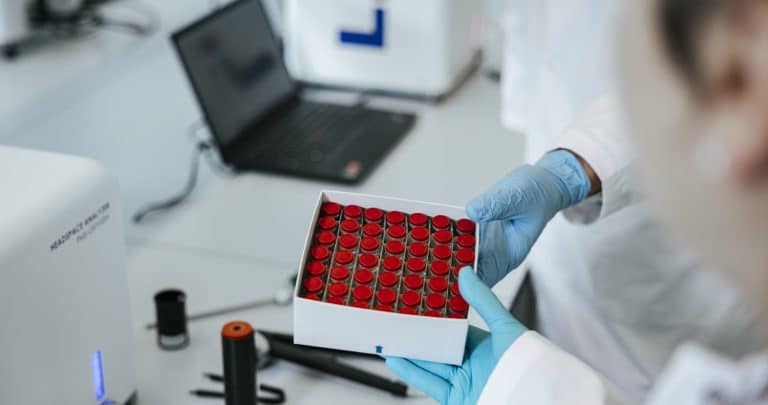
In this example a pharmaceutical company needed a validated CCIT method for 15R vials containing protein-based liquid products. Traditional blue dye testing proved inadequate for this complex formulation, so they decided to use a deterministic approach that could reliably detect microscopic defects.
The Challenge
The drug product consisted of a protein-based solution—a known challenge due to their tendency to clog microdefects and potentially limiting gas flow. Therefore, defects were created that intentionally had interaction with the protein-based solution, to assess the sensitivity of the method.
Method Development
We developed a customized headspace analysis-based CCIT method using carbon dioxide as a tracer gas. This deterministic approach provides superior defect detection capabilities over traditional blue dye ingress testing.
Positive Control Strategy: We evaluated multiple positive control approaches including laser-drilled and micro-wire defects. Laser-drilled controls provide defined defect sizes for sensitivity assessment, while micro-wire controls simulate realistic manufacturing defects such as fibers caught in the seal.
Conditioning Optimization: Through systematic evaluation, we established optimal conditioning parameters at 30-minute CO2 overpressure cycles that achieved the required sensitivity while maintaining method robustness.
Formulation Compatibility: The laser-drilled defects were positioned both underneath and above the liquid fill. For the micro-wire defects, the vials were inverted three times prior to performing the CCI test to ensure the fill came into contact with the defect.
Results
The developed method demonstrated consistent detection of defects ≥5 μm in the product-filled vials. 2 µm laser-drilled vials were harder to detect below the liquid fill level, which was consistent with expected detection limits.
By adapting the test cycle duration and overpressure settings, the method can be further tailored to meet both sensitivity and practical throughput requirements, if needed.
For a related example, see our case study on CCI test method validation for prefilled syringes.

Book a Validation Consultation
Whether you’re launching a new parenteral product or upgrading your CCIT strategy, we can help tailor a method to your specific container closure system. Our team of analytical experts has many years of experience and successfully validated deterministic CCIT methods for pharmaceutical companies worldwide.
With LIGHTHOUSE’s approach, you’ll receive:
- Scientific & Regulatory Expertise: Deep understanding of both pharmaceutical manufacturing realities and regulatory requirements
- Technical Knowledge: Proven experience with deterministic CCIT methods using headspace analysis across diverse container closure systems
- Practical Solutions: Method development approaches that balance regulatory compliance with operational efficiency
- Implementation Support: Comprehensive assistance from initial method design through validation completion
Ready for a smarter container closure integrity testing strategy?
Contact our CCIT experts today to discuss how we can help you achieve compliance while improving operational efficiency.
Frequently Asked Questions About CCIT
Method development follows USP <1207> for package integrity evaluation, and validation protocols are designed according to ICH Q2(R2) and other applicable global regulatory requirements.
The approach consists of three steps:
- Step 1: CCIT Method Feasibility & Scope, which assesses product-package characteristics and method feasibility
- Step 2: CCIT Method Development, which optimizes instrument performance, product baseline levels, and product-tracer gas interaction
- Step 3: CCIT Method Validation, which confirms the method using a validation protocol
Validation confirms that the method reliably distinguishes between leaking and intact containers and establishes its limit of detection (LOD). This is demonstrated by testing positive and negative controls across multiple runs and operators, and for multi-site manufacturers, protocols are designed to support method transfer between facilities.
During conditioning, samples are placed in a CCI test vessel that creates a controlled, pressurized CO2 environment, allowing tracer gas to enter through any potential leak paths before headspace measurement.
Yes. By adjusting test cycle duration and overpressure settings, a headspace-based method can be tailored to balance required sensitivity with practical throughput requirements.