Knowledge Center
Correlating Headspace Gas Ingress Testing to Helium Leak Rates
Container closure integrity (CCI) testing confirms that a sterile product package maintains its physical barrier throughout the product life cycle. USP <1207.2>, Package Integrity Leak Test Technologies, lists both helium leak rate testing and laser-based headspace analysis as Row 1 deterministic leak test technologies for sterile product-packages. This means that both technologies are considered the most sensitive at detecting defects. A direct correlation between the two methods, run on the same positive control vials, shows how closely these two technologies compare to each other with regards to sensitivity.
The limits of helium leak testing in production
Helium leak rate testing is typically used to generate CCI data in early package development. In a typical set-up, a sample is constantly purged with helium at atmospheric pressure through an opening in the container base, while the cap end sits in a vacuum chamber connected to a spectrometer. Only one sample can be tested per run, the method is destructive, and sample preparation can become time-consuming — factors that limit its application later in the product life cycle, when testing needs to cover larger, more representative sample sets.

How the correlation study was designed
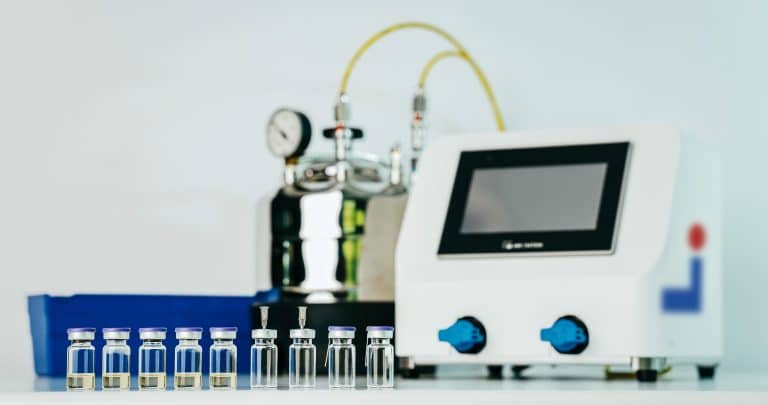
The study tested proprietary positive control vials with leak rates of 10-8, 10-7 and 10-6 sccs. The same controls, on both 2R and 10R glass vials, were measured first by helium leak rate testing and then by CO₂ headspace gas ingress testing using an FMS-Carbon Dioxide Headspace Analyzer.
For the headspace method, samples with an initial headspace of 1 atm ambient air were placed in a CCI test vessel, purged to a 100% CO₂ atmosphere, and pressurized to 2 atm CO₂. Headspace CO₂ partial pressure was measured at intervals, and a CO₂ ingress rate was calculated from the ingress observed over time.
Correlation results: R² ≥ 0.98 across two repetitions
The two methods produced similar leak rates detection capabilities. Across two separate repetitions of the experiment, the R² coefficient was ≥ 0.98 for both 2R and 10R glass vials, indicating a strong relationship between the helium leak rates and the CO₂ ingress rates measured on the same positive controls. Using CO₂ as a tracer gas, the headspace method detected leak rates as low as 10-8 sccs — two orders of magnitude below the 10-6 sccs lowest leakage rate described in USP <1207.1>.
What this means for method selection
Headspace gas ingress testing can offer an alternative to helium leak testing for generating CCI data, with the added advantage that the same technology can be used throughout the product life-cycle. It is non-destructive, can be configured for higher throughput to cover statistically relevant sample sets, and can be run on actual product samples rather than dedicated positive controls. The correlation data here indicates that laser-based headspace analysis can generate robust, science-based CCI data, that is comparable to helium leak testing. It should therefore be strongly considered by teams looking for a deterministic method that can be applied consistently, from early development through routine batch testing.
The full study, including the correlation plots for 2R and 10R vials and the complete experimental procedure for both methods, is available in the article below.