Knowledge Center
Evaluating Elastomer Resealing Capacity with Non-Destructive Headspace Analysis
Elastomer resealing capacity is the ability of a rubber stopper to close again after a needle has pierced it. Under the old USP <381> section 4.3.3, self-sealing capacity was evaluated with a probabilistic blue dye immersion test. With USP <382> becoming official December 1st 2025, there has been a shift from probabilistic CCI testing to deterministic CCI testing. USP <382> section 5.2 “Needle Self-Sealing Capacity” explicitly refers to USP <1207> for leak test method selection.
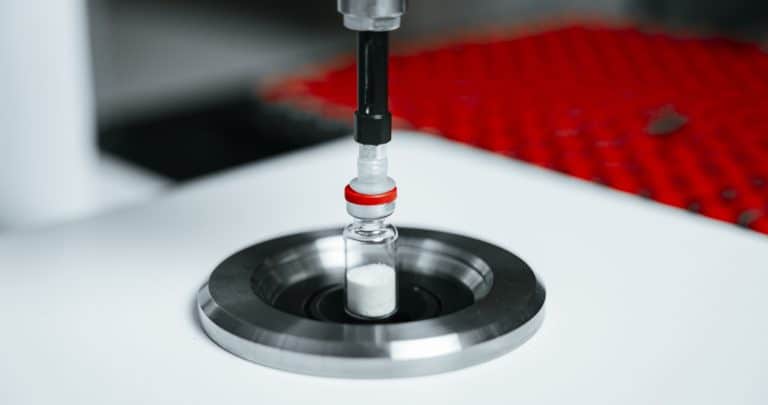
This article shows how non-destructive, laser-based headspace analysis can evaluate stopper resealing both during repeated punctures and in a follow-up container closure integrity (CCI) test.
Why multi-dose products need resealing data
When a healthcare professional or patient pierces a multi-dose vial several times, the stopper must reseal each time to prevent microbial ingress and product loss. Historically, elastomeric components were tested in isolation by the supplier. USP <382> instead requires a systems approach, in which the entire assembled packaging and delivery system is evaluated for fitness for intended use.
For resealing, that means testing punctured closures on your own container. Section 5.2 requires that the leak test method chosen can verify in-use integrity against the in-use maximum allowable leakage limit, and points to USP <1207> for method selection and validation. For the full scope of the chapter, see our overview of USP <382> requirements for elastomeric components.

How resealing is measured in real time
The study used 2 mL and 20 mL glass vials with crimp-sealed elastomeric stoppers. Test samples were sealed under either nitrogen or vacuum and punctured multiple times with syringe needles. USP <382> section 5.2 asks for testing after the final puncture; this study also monitored resealing during the puncture protocol.
- Nitrogen headspace: headspace oxygen was measured after each puncture. Most stoppers resealed rapidly, with minimal change in oxygen. In one isolated case, a sample showed a significant oxygen increase after multiple punctures, indicating the stopper no longer resealed.
- Vacuum headspace: headspace pressure was monitored continuously. In the 20 mL vials, the temporary leak path created by needle removal typically closed within seconds.
The follow-up CCI test evaluated all these samples.
What the CCI data showed
All samples were then conditioned in a carbon dioxide tracer gas vessel and measured non-destructively with laser-based headspace carbon dioxide analysis at three timepoints: before conditioning, immediately after removal and after several hours at ambient conditions. Positive controls included certified laser-drilled defects and gross defects.
A pass/fail threshold carbon dioxide was established from measurement uncertainty and baseline carbon dioxide levels. Using this threshold, the method:
- Reliably detected defects with a flow-effective size at least as small as 5 µm
- Showed no false positives in intact samples
- Gave repeatable results across both vial sizes
Detected leaks remained measurable for hours after removal from the vessel, a practical window for routine testing. All 20 mL test samples maintained CCI. All 2 mL samples except one did too, and that single failure was the same vial that had shown elevated oxygen during puncturing. Two independent measurements pointed to the same permanent leak.
Building a resealing study into USP 382 compliance
Because the measurement is non-destructive and takes just seconds per sample, the same vials can be re-measured, and large sample sets can be tested. The same method approach can be used further along the product life cycle, for example in stability studies, batch release and investigative testing.
Headspace analysis also detects temporary leaks as well as permanent ones: a brief loss of integrity leaves a change in headspace gas that can still be measured later. This is particularly relevant for freeze-dried products, where raised stoppers before capping can create temporary leaks that the other deterministic methods listed in USP <1207> cannot detect.
To plan your own container closure integrity study, start with the USP <382> requirements for your container-closure system. For a related example of closure system testing, see our case study on CCI test method validation for prefilled syringes.
Prepare your resealing study for USP 382
Download the article for the full study data, or talk to one of our application scientists about evaluating the self-sealing capacity of your multi-dose packaging.