Knowledge Center
Water Activity: A Better Approach for Lyophilized Moisture Determination
Residual water in a freeze-dried product exists in different states: bound water (adsorbed, chemically bound or water of crystallization) and free water. Only the free, or active, water is available for chemical reactions, so it is free water that drives product stability. Water activity measures exactly that fraction, while total water content does not distinguish between the two.
For historical reasons, the pharmaceutical industry standardized on total water content as its primary moisture quality parameter, while most other industries, the food industry in particular, standardized on water activity. This article by Derek Duncan, PhD, makes the case for water activity in lyophilized product. For the broader application, see our overview of water activity determination.
The limits of Karl Fischer titration
Karl Fischer (KF) titration is the most widely used residual moisture method for freeze-dried product and remains a valid compendial method. It measures the total water in the cake, assuming the sample is wholly soluble in the KF medium. Thermogravimetric analysis (TGA) measures weight loss on heating, so it also captures any other volatiles driven off, and the composition must be well understood.
Neither method distinguishes between the states of water, and both destroy the sample. In a stability study, vials must be destroyed at each time point for each parameter, so sample sets are kept small to protect scarce material, and the vials tested at a given time point are implicitly assumed to be identical.

How water activity is measured non-destructively
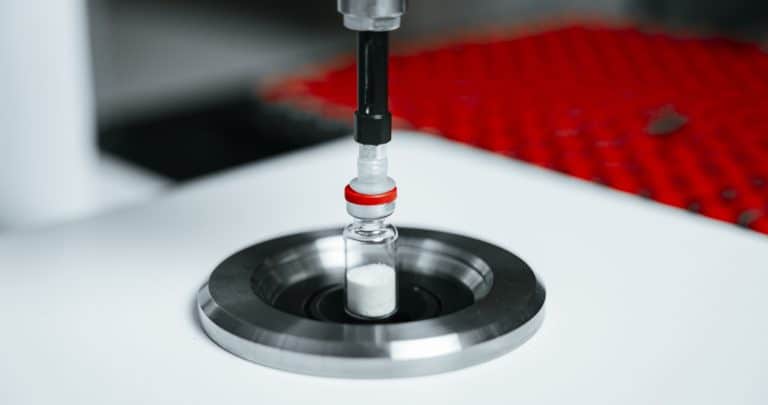
Tunable diode laser absorption spectroscopy (TDLAS) measures the water vapor partial pressure in the headspace of a sealed vial. That is a direct measure of the thermodynamic activity of the free water in the freeze-dried cake.
USP <922> Water Activity describes the Optical Hygrometer – Tunable Diode Laser, and existing headspace moisture analyzers such as the FMS-Water Activity and FMS-Pressure/Moisture analyzers are considered optical hygrometers. As the chapter puts it: “It is important to establish what fraction of the total water is available (active), and the determination of water activity (aw) provides this information.”
Comparing the two methods
| Karl Fischer titration | Laser-based headspace water activity | |
| What is measured | Total water in the freeze-dried cake, assuming the sample is wholly soluble in the KF medium | Water vapor partial pressure in the vial headspace, a measure of the thermodynamic activity of the free water |
| Distinguishes states of water | Bound and free water are measured together | Measures the free (active) water available for chemical reactions |
| Destructive | Yes: the sample is destroyed during analysis | No: the sealed vial is measured intact |
| Stability study implications | Vials destroyed at each time point for each parameter; sample sets kept small; tested vials assumed identical | The same vials can be measured at each time point and returned to storage |
| Practical handling | Time-consuming; requires operator expertise and careful sample handling | Rapid; well suited to analyzing large numbers of samples |
| Compendial context | The most widely used residual moisture method for freeze-dried product today | Described in USP <922> as the Optical Hygrometer – Tunable Diode Laser |
What non-destructive measurement makes possible
Freeze dryer equivalence. 100% headspace analysis of a 5% sucrose placebo, dried with the same defined cycle in two freeze dryers, showed they were not equivalent. Freeze Dryer 1 produced wetter product in the center of the shelf, slightly above target. Freeze Dryer 2 showed much more variability, with edge vials at target and center vials much wetter. After optimizing formulation and cycle, both dryers produced uniform moisture across the shelf, all within the desired range.
Stability correlation. Samples at 0.5%, 1.0%, 1.5%, 2.0% and 3.0% w/w were stored at 25°C, 40°C and 60°C. Headspace moisture was measured non-destructively at each time point and the samples returned to storage; a subset was tested destructively by KF and HPLC. The results showed an excellent correlation between the log of the degradation constant and the headspace water vapor pressure. Once the stability profile is established as a function of water activity, the stability of a vial can be predicted from a rapid, non-destructive headspace measurement.
This matters because typical freeze-drying cycles target 1% to 3% water by weight, and “the drier, the better” does not always hold. Large biopharmaceutical molecules can be over-dried, as proteins depend on small quantities of water to maintain higher-order structure, so some cycles need both a minimum and a maximum moisture specification.
Water activity complements Karl Fischer rather than simply replacing it: KF characterizes total water, while headspace analysis delivers statistically relevant data on the free water that drives stability. Headspace analysis is also used for 100% container closure inspection of freeze-dried product in quarantine. For oral solid dosage forms, see water activity and primary packaging selection, and for the full range of methods, our moisture determination overview.
Evaluate water activity for your lyophilized product
Download the article for the full case study data, or talk to one of our application scientists about adding water activity to your residual moisture program.